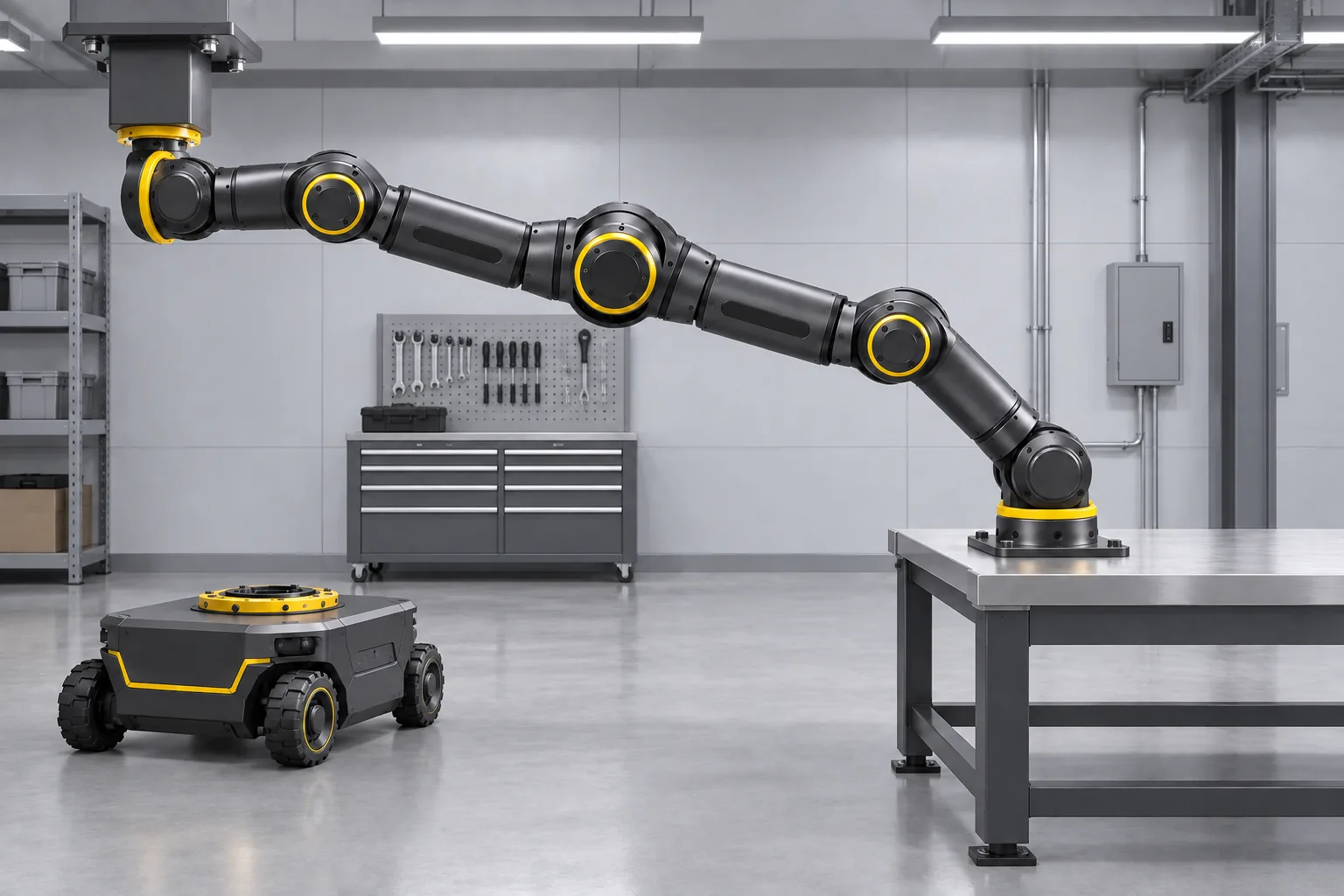
Access by switching rides
The arm switches between AMRs and legged platforms, so it enters the workspace regardless of whether any one platform can get in.
Move your cursor and the arm follows. Click a box to move that box, or a yellow docking port to send the arm there.
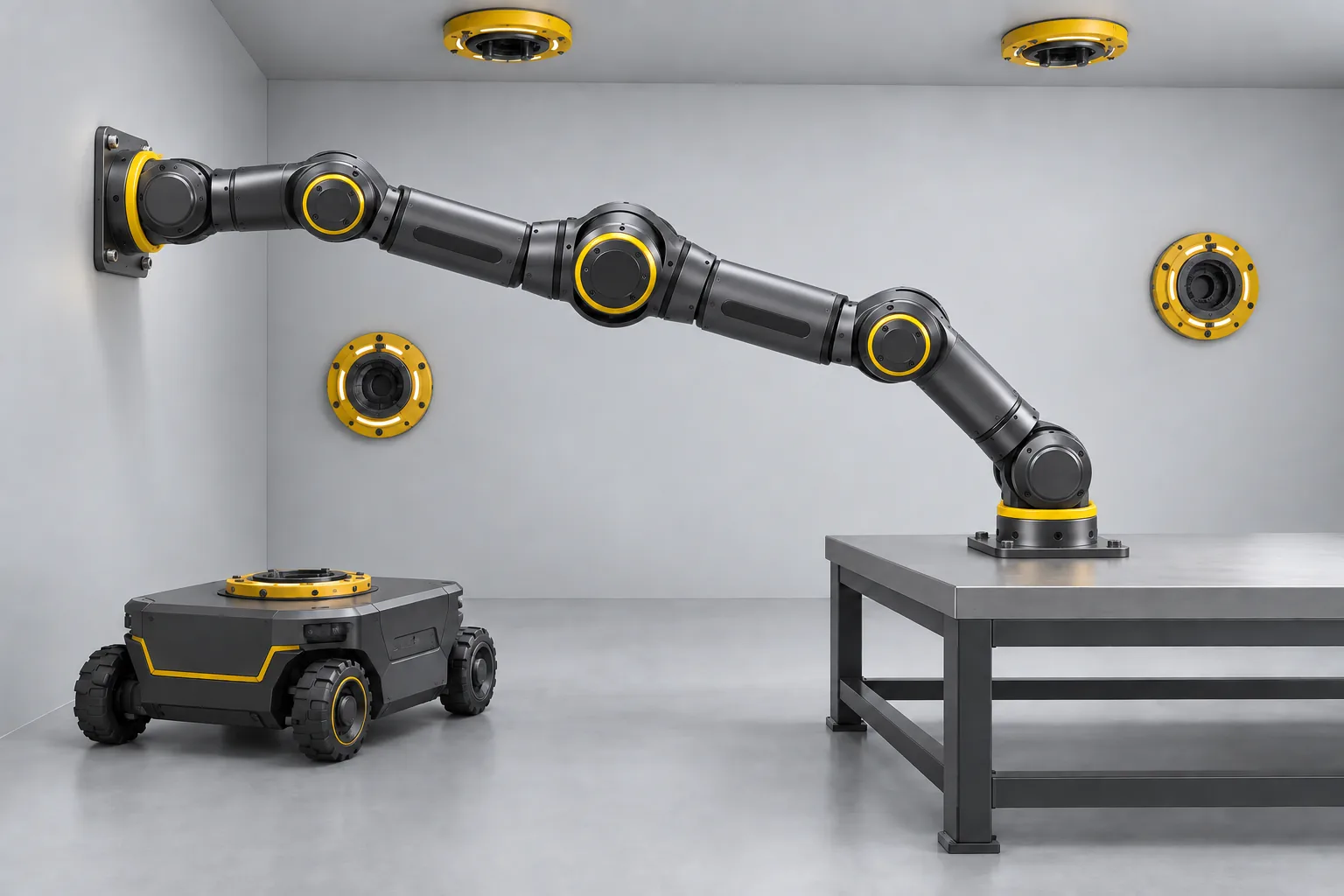
DN Robotics' symmetric docking manipulator separates the base it travels on from the base it works from. Put identical docking ports on ceilings, walls, floors, workbenches, AMRs and quadruped robots, and the arm moves itself from port to port.
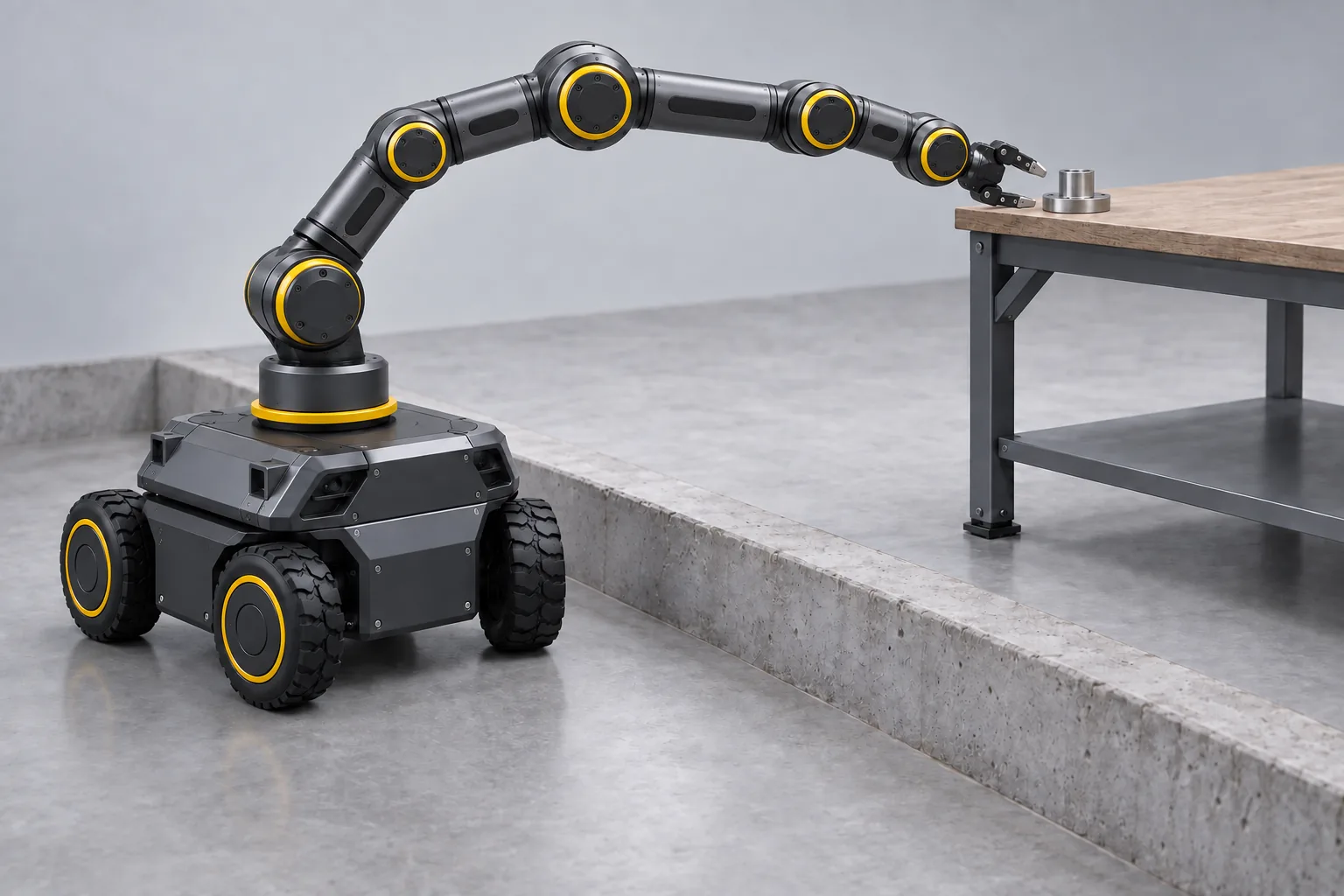
A manipulator is a robot that does its work through an end effector mounted at its tip. To reach the work point, it has either been installed in a fixed position or carried on an AMR or a biped or quadruped platform. But because the arm and the mobile platform share a single base, every constraint of the mobile platform carries straight over to the arm’s work.
If the AMR cannot get over a door sill or a cable tray, the robot arm cannot enter that workspace either.
For a fixed arm, where the robot stands decides its work area. In a space beyond its working range, such as a wide workbench, the end effector cannot reach the work point.
Reaction forces from the work travel back into the mobile platform. On biped and quadruped platforms, the body’s posture control and the arm’s control have to be handled together, which makes control for precision work more complex.
Solving these problems the conventional way meant bringing in a different robot for every environment, or heavily rebuilding the existing workspace to suit the robot.
We propose a docking manipulator that separates the base it travels on from the base it works from. Instead of improving the means of travel, we made the arm itself detachable, an approach inspired by the way Canadarm2 on the International Space Station moves by docking. The arm has an identical docking interface at both ends, and docking ports of the same standard are placed on mobile robots and at work reference points.
Docked to an AMR or a legged platform, the arm travels to the entrance of the work area.
Only after that lock is confirmed does the mobile-platform side undock.
The detached mobile platform moves off to its next job.
When the working range runs out, the arm moves like an inchworm to a nearby docking port and repositions itself.
Because the arm switches between means of travel, it enters the workspace regardless of whether any one platform can get in.
When reach is a problem, the arm moves to a port near the work point and relocates its working range. Instead of building a longer arm, add one more port.
Some problems only exist on mobile platforms that can never be fully fixed. The arm moves directly onto solid structure to work, and gains stability.
No heavy renovation or building from scratch. Installing ports where they are needed and preparing a means of travel that suits the site is enough.
In this sense our docking port is not just a fixture. It works as a standard adapter that connects many kinds of mobile platforms with the robot arm.
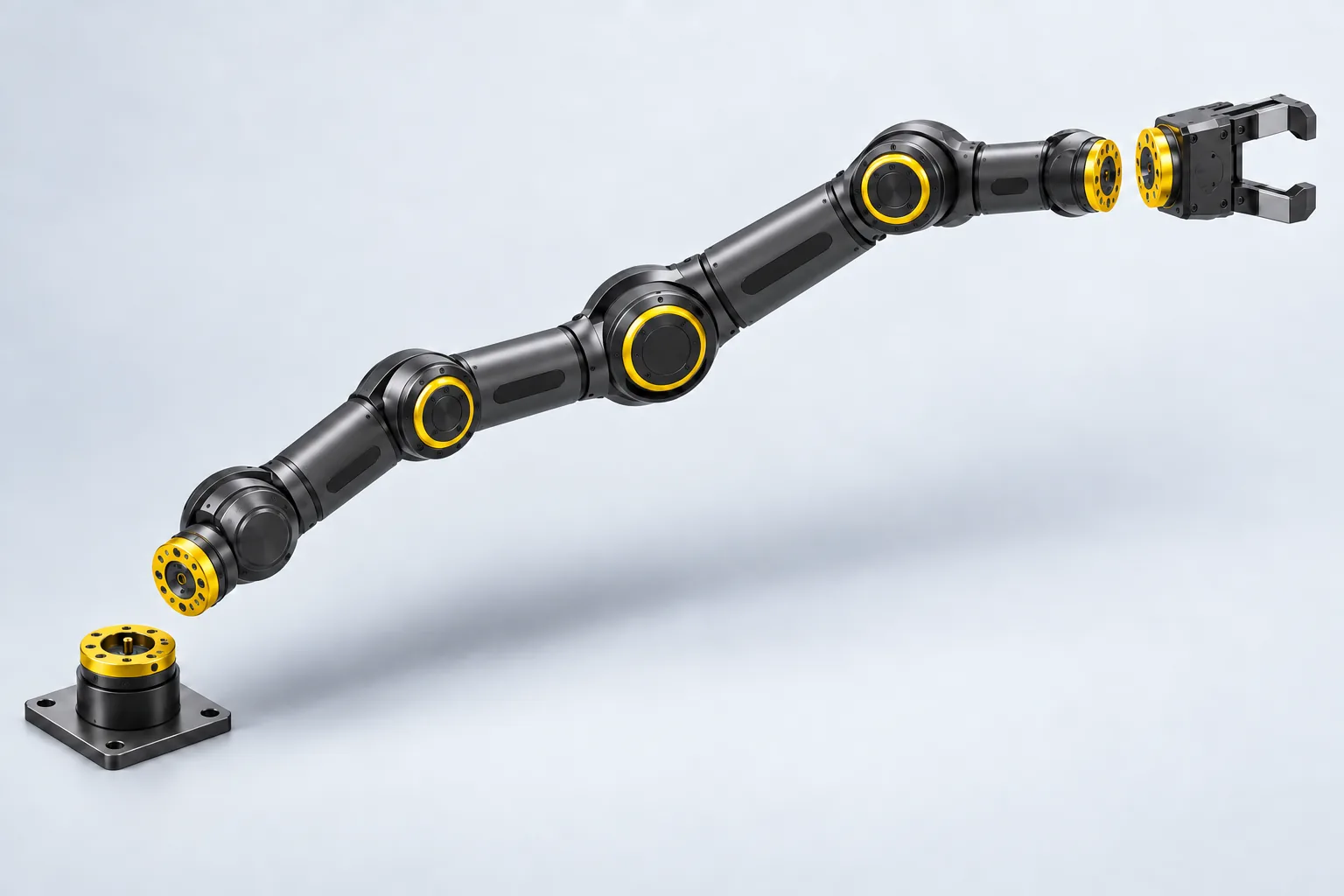
The system consists of the symmetric manipulator body, standard docking ports and modular end effectors. The docking ports come in the five types below under a single standard, placed to fit the structure of the site. The manipulator moves between ports by itself and works from a fixed base at each work point.
A latch structure that stays locked even if power is suddenly cut guards against falls. The entry is wide and narrows toward the inside to absorb actuator error, and the play that comes with latches is taken up by a separate locking actuator and the mechanical design.
An ArUco marker and a camera identify the port, and the position and orientation errors that arise while approaching it are corrected.
Once docking is complete, the kinematic reference switches using the port ID and the pre-registered port coordinates, and an IMU verifies the orientation of the mounting surface.
The sequence is enforced so that the old lock is released only after the opposite end is confirmed locked. The lock is built in duplicate so that a single failure does not lead to a fall.
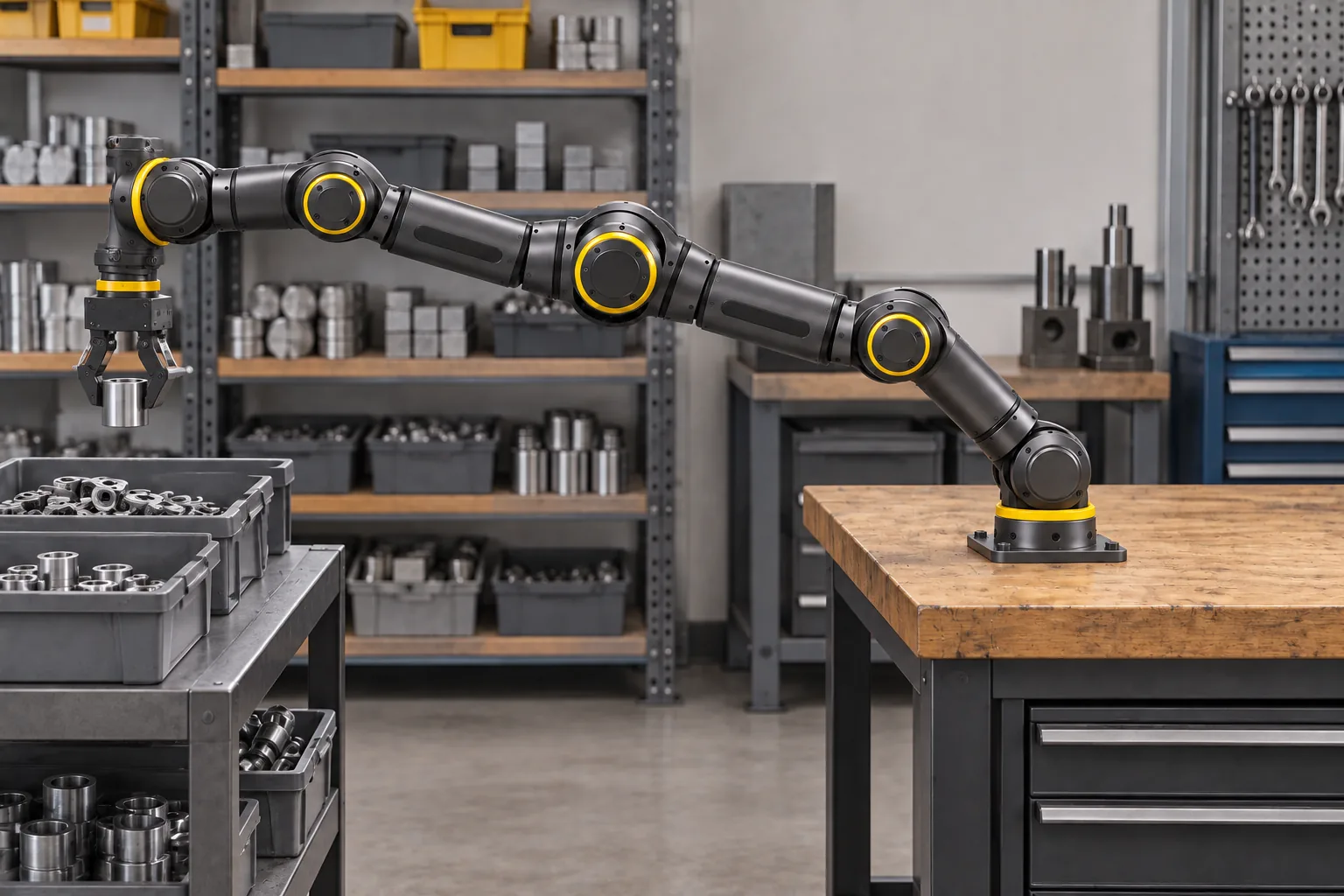
Conventional automation often required changing the work environment itself to suit the robot. The site’s structure had to be reworked, and that cost money. So small facilities, where mobile robots have limited access or the capital for many robots is lacking, have found automation hard to adopt despite high demand for it.
Instead of rebuilding the whole facility, docking ports are installed where the work is needed. The site’s structure and workflow can be kept as much as possible.
Apply it first to the processes where automation pays off most, then widen the scope step by step as operating results come in.
Use an AMR in open spaces and a legged platform in narrow spaces or where there are steps, approaching each site on its own terms.
When a new work point appears, add a port instead of a whole robot, so that one arm covers a wider area.
| Approach | Strength | Limit |
|---|---|---|
| Fixed collaborative robot | Precision | Working range tied to the install point |
| Mobile manipulator | Can move | Floor obstacles and aisle width |
| Biped and quadruped platforms | Excellent access | Payload and precision control |
| DN Robotics | Separates the travel base from the work base to achieve mobility and working stability at the same time | |
If the table looks cut off, swipe left or right.
Use an AMR on open ground, and let a legged platform do the carrying where an AMR cannot go. Once in the work area, the arm moves between ports by itself to widen its range.
When it needs to lift more or work more precisely, the arm moves to a fixed base, or onto an AMR, which is more stable than a legged platform.
When work points increase or the site layout changes, no additional robots are needed. Just add or relocate docking ports, and one body does the job of several.
Base locking and tool changes share the same standard. Moving and changing tools run on the same mechanism, so both are automated as they are.
To secure these differentiators as a technical advantage, we plan to protect the docking mechanism and the correction control method with patent applications.
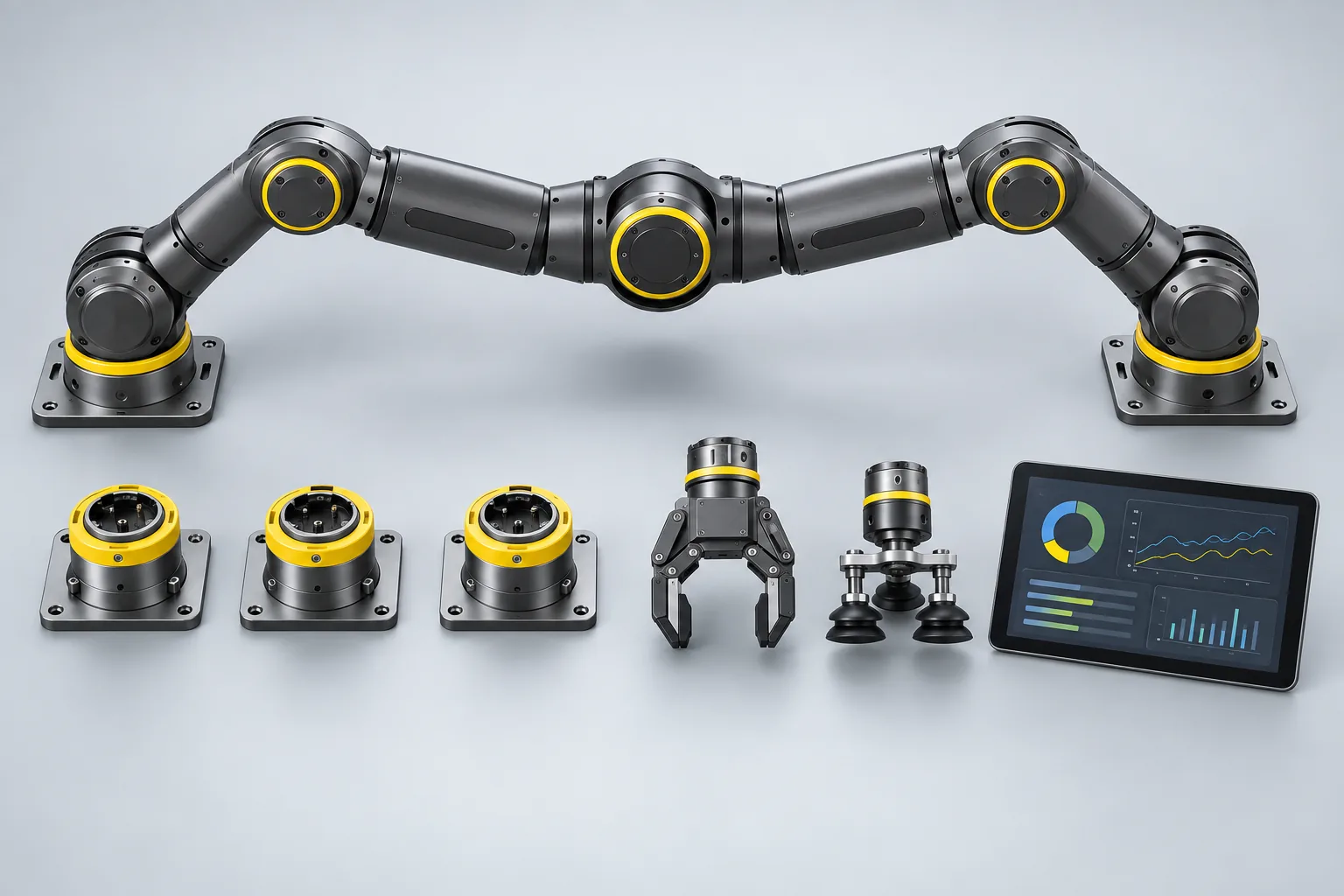
With a modular structure that separates the body, docking ports and end effectors, the configuration each site needs can be combined flexibly.
The body, docking ports and end effectors are provided together as one package.
Docking ports and end effectors are added module by module to expand the working range flexibly.
Operating data such as docking position error, joint load and retry counts is monitored in real time without extra equipment, with anomaly detection and predictive maintenance.
The body, docking ports and end effector set are provided as one package. Site survey, port layout design and initial setup are all included in the integration contract.
Supplied as a kit users install themselves with no integration contract, with docking ports and end effectors sold separately so users can widen their working range step by step.
The B2C channel is used to gather a wide range of application cases and build up real operating data. The dimensional specification and basic control of the low-cost docking interface are published, while the detailed implementation of the locking mechanism and the docking correction algorithm are not. As cases customized by users accumulate, they become references for B2B sales and a route to discovering new applications.
The arm switches between AMRs and legged platforms, so it enters the workspace regardless of whether any one platform can get in.
When the target is hard to reach, the arm moves to a nearby docking port and relocates its working range. Instead of a longer arm, add one more port.
No major changes to the workspace. Install ports where they are needed and prepare a means of travel that suits the site.
Sign up to use private Q&A and personalized notifications.
Contact dnrobotics23@gmail.com · @dnrobotics23
Four of us studying robotics at the Department of Robot Engineering, Hanyang University ERICA.
Team lead
Software
Software
Hardware